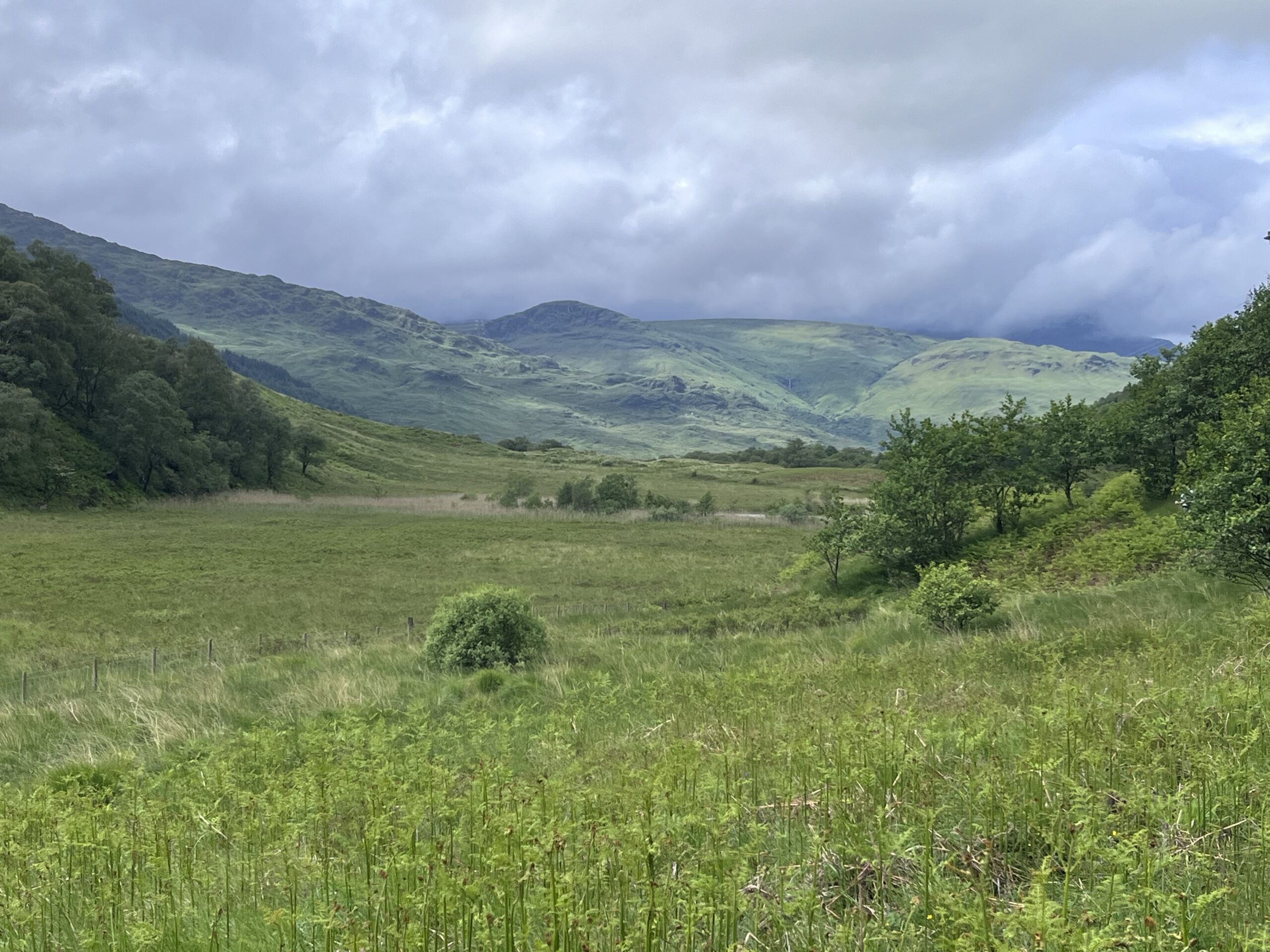


The Destination
In late May, I found myself looking at a window of two weeks in June, wondering how best to fit in an adventure. Super long flights would eat up a lot of the available time. Having to travel a long distance from wherever I would fly in, is the same problem as above in another form. It was also solidly in the shoulder season: still a bit too early for a lot of the higher elevation classics in the Northern hemisphere, and maybe a bit late (shorter days, colder temperatures) for the Southern hemisphere classics.
Ideally, the place would offer some kind of a cultural experience, or sights of interest beyond just the hike. And not require a ton of planning ahead, since I only had a few weeks to go.
Working within these constraints, K (who was saying yes to opportunities coming her way) and I landed on: Scotland. The West Highland Way to be precise.
The Hike
The West Highland Way is one of Scotland’s most famous long-distance hikes. It runs from Milngavie, on the outskirts of Glasgow, to Fort William, going from the Lowlands, and crossing the Highland Boundary Fault into the Highlands. The official length is 154 kms, or nearly a hundred miles.
The route connects many ancient paths, such as old military roads and drover’s roads, and passes by some fairly ancient businesses too, such as the Clachan Inn (where we stopped for dinner on Day 1) and the Drover’s Inn (where we spent the night on Day 3). All of these are proper old. Like centuries old.

For the most part, the gradient is mellow and the terrain is not technical at all. The highest point of the Way is only 550 m, at the summit of Devil’s Staircase. But the distance, the distance is a lot. The most I’d have ever hiked in one trip.
The Plan
The best part of this trail is that you can go at your own pace and do it your own way: from fully self-propelled (carrying all your gear and camping along the way), to fast and light (staying at inns and using a luggage transfer service). Camping of course gives you the most flexibility. Except for a stretch along Loch Lomond, you can camp practically anywhere you want, thanks to the freedom to roam laws in Scotland. But staying at inns gives you the chance to shower every night, dry out wet gear, and protection from the midges.
We opted for something in the middle. We chose to stay at inns and bunkhouses, but we carried all our personal items and supplies. This is the least flexible option; we had to make reservations for all the nights as soon as we had decided.
Getting There
We flew in and out of Edinburgh.
There are multiple modes of transport connecting Edinburgh with Glasgow, which is approximately one hour away. I opted to take a Flixbus there. From Glasgow, we took the commuter train to Milngavie, then walked to the starting point.
For the way back, we booked an Ember bus to take us directly from Fort William to Edinburgh. We did end up having to take a different route (Fort William → Glasgow → Edinburgh) since the driver for this bus fell sick, but that’s a different story.
The Itinerary
We went with the ‘average’ recommendation of 7 days on trail.
But since the Way ends at Fort William, at the foot hills of Ben Nevis. It was only logical to tack that on. How could we leave the highest point of UK unsummitted?
With K only able to take 10 days off, our itinerary was
| Day | Plan | Stay | Hiking distance (official) |
| 1 | K arrives, Edinburgh → Glasgow → Milngavie (public transport), Milngavie → Drymen (hike) | Drymen | 19 km |
| 2 | Drymen → Rowardennan | Rowardennan | 24 km |
| 3 | Rowardennan → Inverarnan | Inverarnan | 22.5 km |
| 4 | Inverarnan → Tyndrum | Tyndrum | 19.5 km |
| 5 | Tyndrum → Kingshouse | Kingshouse | 30.5 km |
| 6 | Kingshouse → Kinlochleven | Kinlochleven | 14.5 km |
| 7 | Kinlochleven → Glen Nevis | Glen Nevis | 21 km |
| 8 | Summit Ben Nevis | Glen Nevis | 16 km |
| 9 | Glen Nevis → Fort William (hike), Fort William → Edinburgh (bus) | Edinburgh | 5 km |
Except for the very last day, we would be hiking an average of 20 kms every day. We would start walking the day K arrived, and end the day before her flight back. I would stay on for a couple of days before and after, to do some sightseeing, rest the old legs and make the most of my two weeks’ vacation.
Hiking Gear
What we packed can be broken down into: day hiking gear, and overnight stay gear. A few notable items
- Rain gear: we packed a rain jacket and rain pants. The latter came in handy for one day of solid rain, but was otherwise unused. The pack liner was clutch though! No need to stop to put on or off a rain cover, or even think about whether it’s raining hard enough for it.
- Bug spray and bug head net: Luckily, neither of them saw much use. The midges did not bother us while we were on the move, and magically, our break locations were nice and breezy and kept them away too.
- Battery pack and charging cables: We ended up never needing the battery pack, since charging overnight was sufficient, and we were always able to charge our phones, watches etc wherever we stayed.
- Water reservoir (2.5 L) and filter: I carried the filter for emergencies, but it turned out to be dead weight (more in the next post).
- Pajamas, camp towel and flip-flops: This, along with toiletries, was my overnight stay gear. I also had a sleeping mask since the sun set so late and rose so early, but never ended up using it.
- Sun protection (sunscreen, sunglasses, hat, sun hoodie): I used the sun hoodie as a lightweight long sleeve hiking shirt and didn’t need much of the rest, but it’s still good to have because we did not know how the weather was going to turn out to be.
- Layers: I had a set of base layers for colder days, a neck gaiter, a lightweight puffy, a fleece sweater, 2 pairs of gloves and warm socks. I hardly used any of this! I could have absolutely done without the fleece, and I should have taken the thicker gloves up to Ben Nevis (but didn’t).
Ultimately, we tried to cover a range of conditions as minimally as we could. Lots of things got used only once or twice, and a couple of items never got used at all. But if I’d really wanted to shed weight, I would have left my camera + lens behind.
In part 2 and part 3, I’ll share day-by-day trip reports. I wrote them in my journal while on the trail, and they are presented here with minimal edits.